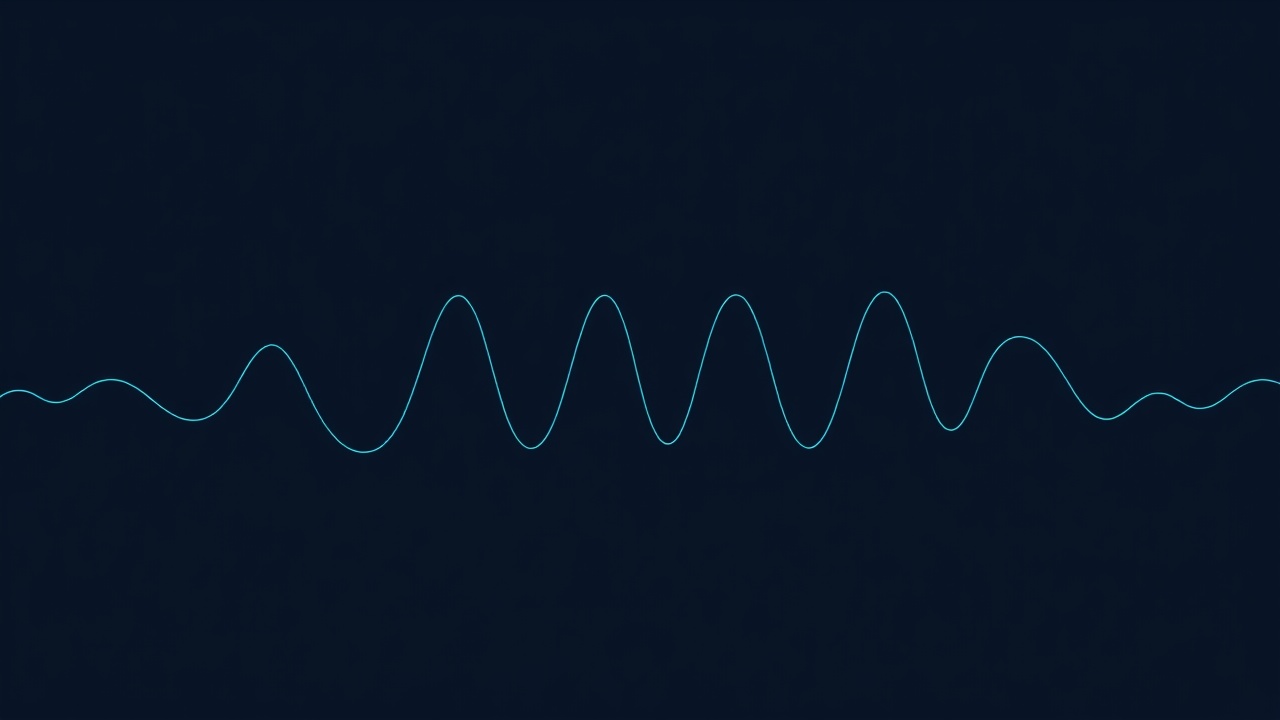
From late January through early February I had two weeks of sessions where the guide RMS was worse than usual — not dramatically so, but consistently 1.1–1.4″ instead of the 0.6–0.8″ I'd been getting through autumn. The RA axis was oscillating with a roughly 40-second period. Dec was fine. I thought it was seeing, then I thought it was polar alignment, then I thought the belt mod had slipped. It was none of those things.
What the logs showed
PHD2's log viewer has a graph tab that shows corrected guide error over time. If you look at only the RMS summary, a 1.2″ session and a 1.4″ session look similar. But when you plot the raw RA error, the oscillation pattern is obvious: a regular sine-like wave with a period of 35–45 seconds and an amplitude of ±0.8–1.0″.
That period is too short for periodic error (my EQ5's PE period is ~480s, consistent with the worm gear rotation). It's too regular for seeing, which produces random scatter. And it wasn't correlating with Dec at all, which ruled out polar alignment drift.
I exported several nights of logs to CSV and plotted them in a spreadsheet. The oscillation was present in every session but varied in amplitude — some nights it was mild (±0.5″), some nights it was bad (±1.2″). The variation didn't correlate with temperature, humidity, or anything environmental I could find.
Ruling out the obvious
Belt mod slippage: I checked the belt tension and the motor coupling. Both were fine. I re-ran the PHD2 guiding assistant to re-measure periodic error and backlash. The measured PE was unchanged from before the problem started. Backlash was slightly higher on RA than I remembered, but not dramatically so.
Polar alignment: I re-did SharpCap polar alignment from scratch. Sub-arcminute alignment confirmed. Oscillation persisted.
Guide star selection: tried different stars, different parts of the field. Same oscillation.
PHD2 settings: reset the RA guide algorithm parameters to default (Hysteresis, aggression 70%). No change. Tried Resist Switch algorithm instead. Slightly different character to the oscillation but still present.
At this point I suspected a hardware problem rather than a tuning problem.
The cable
The EQ5 Pro connects to the PC via a USB-to-serial adapter cable — the one Sky-Watcher ships with the mount. The cable is about 3 metres long and I route it through a cable management clip on the pier extension.
I noticed, while fiddling with the mount one evening, that if I touched the cable near the mount's hand controller port, the guiding graph would spike. A definite connection between mechanical disturbance and guide error. I wiggled the connector at the mount end and felt a tiny amount of play that shouldn't have been there.
The USB connector on the hand controller had a partially fractured solder joint on the shield ground. Intermittent contact — enough to maintain communication (no disconnects logged) but apparently introducing noise or small command delays that the mount controller was interpreting as guide pulses or ignoring unpredictably.
I resoldered the joint. Total repair time: 15 minutes including finding the soldering iron.
After the fix
First session after the repair: guide RMS 0.62″. Second session: 0.71″ (wind). Third session: 0.58″. Back to normal.
Looking back at the logs, the oscillation started around 2026-01-22 — the night I moved the mount to a slightly different position on the rooftop and had to extend the cable routing. I almost certainly induced the connector failure then by putting stress on the cable, and I spent two weeks blaming the weather and my alignment technique.
Lessons
- When guide behaviour changes suddenly, look for what physically changed first, not what settings changed.
- The PHD2 log viewer's time-domain plot is more useful for diagnosing oscillations than the RMS summary. Export and plot if the built-in view isn't enough resolution.
- A regular oscillation with a period much shorter than the worm period is almost always a cable or electronics issue, not a mechanical one.
- Replace the stock USB cable. The Sky-Watcher one is fine until it isn't, and the connector quality is not great. I've since switched to a short, high-retention USB-B cable with a ferrite bead.
Two weeks, maybe 8 hours of wasted session time, fixed with a soldering iron and 15 minutes. The usual story.