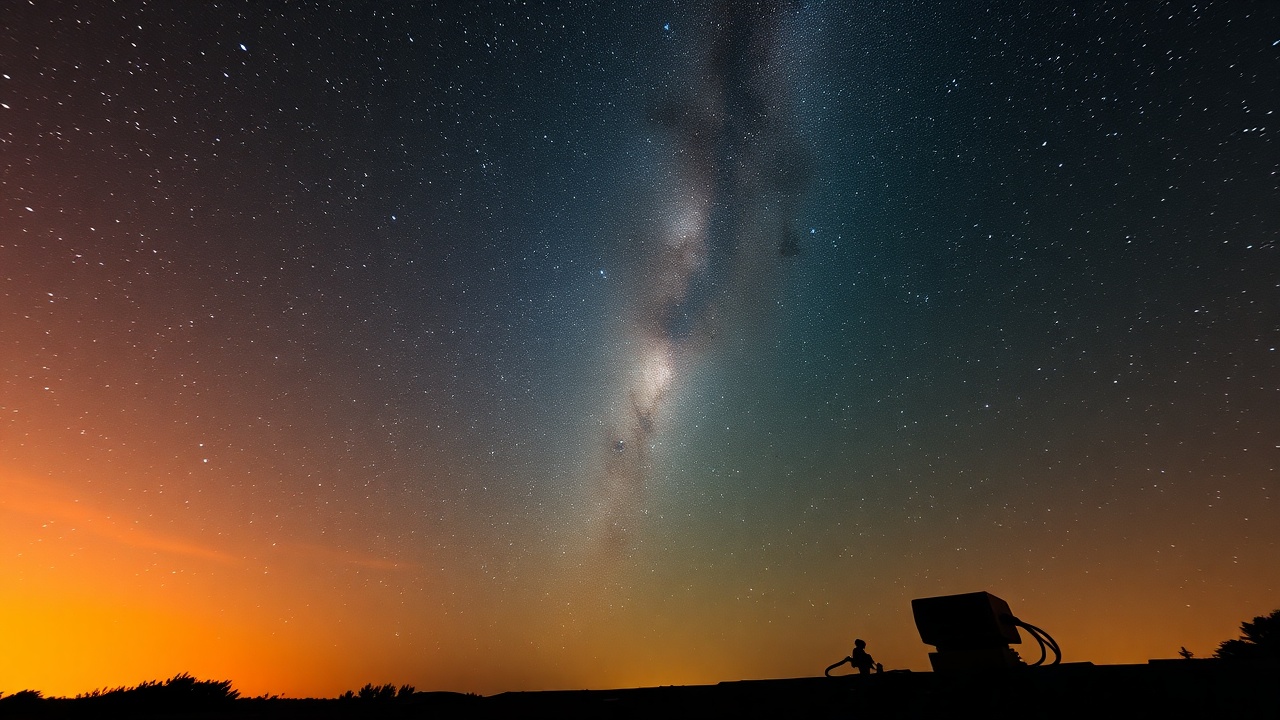
The lens arrived on a Tuesday. By Thursday the seeing forecast looked tolerable — not good, but the Milky Way core was still well-placed at sunset and I didn't want to wait another week. I set up on the rooftop around 21:30, did a quick polar alignment, and started shooting by 22:15.
Why the Samyang 135
I'd been using a Canon 50mm f/1.8 on a modified 600D for about a year. The 50mm is a fine starting lens — fast, cheap, optically decent stopped down — but I wanted more reach and I was tired of calibrating a DSLR. When I switched to the ASI294MC, the natural next step was a proper imaging lens at a longer focal length.
The Samyang 135mm f/2 ED has a reputation in the AP community that's almost suspiciously good for the price. Two ED elements, manual focus only (which is actually an advantage — no focus hunting mid-session), and the coma is reported to be minimal wide open. I bought a used copy for €230 from a local photography forum. Physical condition was excellent, glass was clean.
Mounting and collimation
The lens attaches via a Baader helical focuser that threads onto a custom-printed T2 adapter. The adapter holds the lens by its tripod collar rather than the mount, which keeps the collimation stable across orientations. First session I was paranoid about this and checked star shape at several positions; it held well.
Focus was the harder problem. At 135mm, focus shift between ambient temperatures is real. I set critical focus using Bahtinov mask diffraction spikes on a 4th-magnitude star, then let the temperature drop for 20 minutes and checked again. The shift over 5°C was small but measurable — maybe half a mask fringe. Not enough to ruin stars, but enough to see in pixel-peeping.
For the actual session I refocused every 45 minutes. Overkill, probably, but this was the first time out and I wanted baseline data.
Coma performance
The coma question was what I was most curious about. At f/2, wide-field lenses typically show comatic aberration in the corners — stars elongated radially, pointing toward the centre of frame like little wings. On the ASI294's 4/3" sensor, the corners are about 12mm off-axis.
My finding: at f/2, corner stars on the ASI294 are slightly elongated but not badly so. A 3-pixel elongation on 4.63μm pixels is visible if you look for it, but not distracting in a final image at normal viewing scale. At f/2.8 it's gone.
I ran the first hour wide open and the second hour at f/2.8 for comparison. The difference in corner sharpness was there; the difference in signal strength was also there. For a Milky Way shot where you want clean noise, f/2 is worth it. For something I'm going to process heavily, I might stop down.
The images
Target was the galactic core region around Sagittarius — 60° altitude at transit from my latitude, which is about as high as it gets here. I shot 180×30s at ISO 800 (gain ~120 on the ASI294 in the corresponding ASCOM setting), ambient temperature 19°C, camera cooled to 5°C. No filter — I wanted to see the broadband signal before worrying about narrowband.
Stacking in Siril: sigma-clipping, 30 darks, 50 flats from a white LED panel, no bias (CMOS sensors calibrate fine without). Background extraction with a polynomial degree 3 — the LP gradient from the south is steep.
The result was better than I expected. The dust lanes in Sagittarius are clearly visible, the star colours are reasonable after a GraXpert correction, and the signal-to-noise is solid despite the short subs. The neighbour's LED contributed a notch of gradient in the lower-left that I had to mask carefully in background extraction, but it didn't ruin anything.
Notes for next time
- Refocus every 30 minutes, not 45. The temperature drop from 22:00 to 01:00 was larger than I expected.
- Try f/2.8 for a full session on a denser star field to properly compare noise floor vs. coma improvement.
- The helical focuser drawtube was slightly stiff. A small amount of PTFE grease fixed it a few days later.
- Mount polar alignment was off by ~4 arcmin in Dec — not critical for 30s subs but worth improving.
Overall: the Samyang 135mm is as good as advertised for astrophotography. For €230 used, it's hard to argue with.