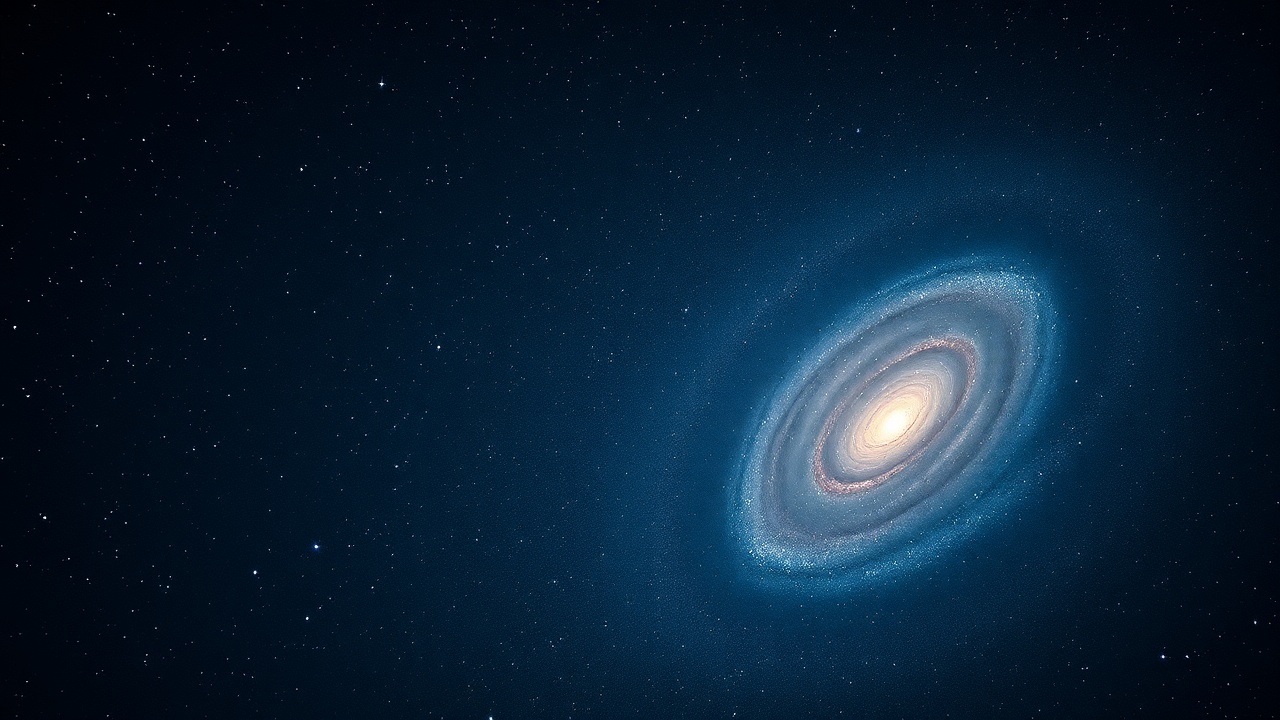
Andromeda is the obvious autumn target from the northern hemisphere — high in the sky, large enough to fit comfortably in the Samyang 135mm's field of view, and bright enough to show structure even in poor conditions. It's also a terrible narrowband target, which makes it a good test of whether the L-eXtreme filter is actually helping from my site or just making things difficult.
The LP problem at 135mm
At 135mm focal length and f/2, a single 75-second sub from my rooftop exposes the background sky to roughly 40% of the sensor's dynamic range. That leaves plenty of headroom for the target signal, but gradient correction becomes critical — the LP isn't uniform, and the neighbour's floodlight adds a point-source component in the south-west corner that no polynomial fit handles cleanly.
The L-eXtreme filter cuts the broadband LP by blocking everything except narrow H-alpha and OIII passbands. For emission nebulae this is transformative. For galaxies, which emit primarily in broadband, it's more complicated.
Andromeda does have HII regions — pink star-forming knots scattered through the disk — and the filter picks those up well. But the galaxy's overall structure is mostly stellar continuum, which the filter suppresses along with the LP. The net result is a lower SNR on the overall disk compared to broadband, but a cleaner gradient situation and punchier HII regions.
Session notes
The session ran from 20:45 to 23:10 on 2 November 2025. M31 was at 50–60° altitude, transiting around 22:00. Seeing was average (Antonie Stott's forecast said 2.5/5), transparency good. Temperature 8°C, falling to 4°C by end. Camera cooled to -10°C.
I shot 96 × 75s at gain 120. That's two hours of integration, which is modest for a narrowband target but reasonable for a galaxy this bright. Rejection during stacking removed 11 subs — mostly the ones during a brief cloud passage around 21:45 and a few with elongated stars when the wind picked up.
Flats were taken the following morning with the filter in place, using the same orientation. One thing I've learned: flats with an LP filter have to be taken at the same temperature as imaging, otherwise the filter's transmission curve shifts slightly and the vignetting correction is subtly wrong. I keep the camera at -10°C for flats even during the day.
Processing
Siril for stacking and calibration. The Siril OSC pipeline handles the L-eXtreme output well — there's a colour calibration preset for narrowband-filtered OSC cameras that sets the initial white balance to avoid the green-star problem the filter introduces.
Background extraction: I used Siril's background model with 200 sample points distributed manually to avoid the galaxy disk and the star-forming regions. The south-west gradient from the floodlight required a custom mask — I drew it in GIMP as a grayscale gradient and imported it as a background mask. Without the mask the polynomial fit tried to compensate for the point source by curving the whole image.
For the final stretch I moved to PixInsight and used GHS (Generalised Hyperbolic Stretch). The HII regions in the disk — the famous pink knots in M31's arms — are clearly visible after a careful stretch. The outer halo is there too, though thin.
What I'd do differently
The narrowband filter was probably the wrong choice for Andromeda specifically. The disk signal-to-noise in the outer regions suffered, and I spent a lot of processing effort recovering detail that a broadband approach with good gradient rejection would have given me more directly. If I revisit M31 this season, I'll try a two-panel mosaic in broadband with longer individual subs — 180s instead of 75s — and use the GraXpert AI gradient correction to handle the LP.
The L-eXtreme stays for nebula work. On the Orion Nebula and the California Nebula last month it performed exactly as expected. But galaxies are broadband targets and should probably be treated that way, even from a polluted site.
The hardest lesson in suburban astrophotography is knowing when to use your tools and when to work around the conditions instead.
Total integration: 85 × 75s = 106 minutes after rejection. All data from 2025-11-02, single night.